Hands-on chart
Best time to skydive in Cairns, by month and by hour
The quick version
The best time to skydive in Cairns is the dry season from May to October, on the earliest slot of the day, with September and October the clearest months.
Timing tips
A jump year in Cairns
Sunrise, daylight and warmth by month
Choose a month to compare sunrise, sunset and day length in Cairns, with the usual warmth and what the records say about cloud and wind.
Sunset
Jan
January averages only 3.7 clear days at Cairns Aero, so keep a spare morning.2
Feb
February is the wettest month, with 480 mm of rain on average.4
Mar
The wet season runs until April, so pack patience as well as a jacket.1
May
The dry season starts in May.1
Jul
July is the coolest month, with an average high of 26.2 °C on the ground.4
Aug
August averages 11.7 clear days at Cairns Aero.2
Sep
September has the most clear days of the year, 12.4 on average.2
Oct
October has the fewest cloudy days, 5.4 on average; book the morning, as 3pm winds average 19.1 km/h.11,15
Nov
The tropical cyclone season begins on 1 November.5
Dec
December brings 172 mm of rain on average as the wet season builds.4
Sunrise and sunset are worked out for the 15th of each month on Queensland time. Day length is for Cairns; temperatures are NOAA averages for the Cairns Aero station (6.1 km, the airport) and rainfall for the Cairns Post Office (1.7 km), 1991 to 2020, measured on the ground.
Cairns has a dry season and a wet season, and a tandem cares about both cloud and wind. The records point to the late dry season and an early slot, but a jump can fly in any month if you leave yourself a spare morning.
Editorial team, cairnsskydive.top · Updated November 8, 2026 · 7 min reading time
Summary view
- Best monthsThe dry season, May to October; September and October are the clearest.1,2
- Best hourAs early in the day as possible, before the weather changes.3
- WettestFebruary, averaging 480 mm across 14 wet days.4
- Cyclone season1 November to 30 April in the Australian region.5
- OctoberDry, with 4 wet days and 11.8 clear days on average.4,2
Two seasons, not four
The best time to skydive in Cairns starts with the calendar of the tropics. Tourism Australia says Tropical North Queensland has a wet season from November to April, while the rest of the year is the dry season.1 It describes the dry months as low in rain and full of sunshine, and as the busiest period for visitors.6 For a tandem, low rain and fewer cloud layers mean more jumps leave on time and at full height.
The wet season is not a closed season. Tourism Australia describes it as bringing heavy rains and tropical storms to Cairns, but showers come and go, and a wet month is not a month without jumps.7 Skydive Australia will still fly through broken cloud or a passing shower, but it grounds a load for a downpour, a gale or a thick, low ceiling.8 The difference between the seasons is the share of mornings that fall into each case.
Crowds follow the good weather. Tourism Australia notes that the dry season brings great weather and larger crowds.9 Skydive Australia accepts bookings from one day to six months ahead and strongly recommends one to two weeks of notice in the peak summer season.10 In practice that means booking early for the dry months and for school holidays, and keeping a spare morning later in your stay in case the first slot is moved.
Cloud and wind
What the sky does through the year
| Month | Clear days | Cloudy days | Wind 9am | Wind 3pm |
|---|---|---|---|---|
| February | 2.5 | 17.4 | 8.9 km/h | 14.6 km/h |
| April | 5.0 | 14.0 | 14.5 km/h | 19.0 km/h |
| June | 8.7 | 10.2 | 15.9 km/h | 18.1 km/h |
| August | 11.7 | 7.5 | 14.8 km/h | 19.6 km/h |
| September | 12.4 | 5.7 | 13.9 km/h | 20.5 km/h |
| October | 11.8 | 5.4 | 11.3 km/h | 19.1 km/h |
| December | 5.6 | 11.7 | 9.2 km/h | 17.0 km/h |
Monthly means at the Bureau of Meteorology's Cairns Aero station, 1941 to 2010.2,11,14,15
Month by month: rain, cloud and clear days
NOAA's averages for Cairns show how sharp the change is. At the top of the scale sits February, the stormiest month of the wet, averaging 480 mm and 14 days that reach 2.5 mm or more; August averages only 27 mm, with 3 such days.4,4 Rain is gauged at the Cairns Post Office and warmth at the airport, both at ground level, so they describe the town and not the sky at altitude, and they tell you nothing about the cloud base that decides a jump.
Cloud is what a skydiver really watches, and the Bureau of Meteorology counts it. Its Cairns Aero records, 1941 to 2010, put the mean number of clear days anywhere from 2.5 in February to 12.4 in September.2 The count of overcast days falls in step, from 17.4 in February to a low of 5.4 in October.11 Those lines cross in the middle of the year, and the late dry season sits on the good side of both.
Temperature barely limits a jump here. The average daily high runs from 26.2 °C in July to 31.8 °C in December on the ground.4,4 It is colder at altitude, and Skydive Australia recommends gloves and very warm clothes in the colder months because it can get quite chilly at 15,000 ft.12 Dress for the door rather than the street, and borrow a fleece and gloves on the day if you travel light.13
The year in Cairns
Rain and warmth, month by month
- Jan11.0 h
- Feb11.3 h
- Mar11.8 h
- Apr12.3 h
- May12.7 h
- Jun12.9 h
- Jul12.8 h
- Aug12.5 h
- Sep12.0 h
- Oct11.5 h
- Nov11.1 h
- Dec10.9 h
Displayed: sun-free hours in mid-month, and days with a minimum of 2.5 mm of precipitation. NOAA, station Cairns Post Office and Cairns Aero, 1991 to 2020.4
Mornings beat afternoons
Wind is the second filter after cloud. At Cairns Aero the average wind at 9am is lower than at 3pm in every month; in September, for example, the means are 13.9 km/h in the morning and 20.5 km/h in the afternoon.14,15 Lighter wind at the door and under the canopy is the practical gain, and it is one reason Skydive Australia steers customers towards the earliest sessions of the day, whatever the month.3
That is why the operator's advice is so simple. Skydive Australia's advice is to take the earliest time available, which gives you the best chance of jumping, because conditions shift as the day goes on.3 It also decides on the weather only on the morning itself and tells customers not to trust the forecast, which it says can cost you a jump on a morning that turns out fine.16 Book early, turn up, and let the people on the drop zone decide.
The calmest mornings in the record are in the wet months, and the windiest afternoons come in the late dry season. In January the average 9am wind is 8.8 km/h; in September the 3pm average reaches 20.5 km/h.14,15 It is the mix that matters: the dry season brings fewer clouds and more wind, the wet season less wind and more cloud. An early slot in the dry season takes the best of both.
Your dates
What to do with the dates you have
Find your situation and the timing that gives the jump its best chance.
If I can choose any month
Go September or October
They have the most clear days and the fewest cloudy ones on record at Cairns Aero.2,11
If I am here in February
Book the first slot
February is the wettest month, but its 9am winds are among the calmest.4,14
If I am here in October
Jump early in the day
October's 3pm wind averages 19.1 km/h against 11.3 km/h at 9am.15,14
If I want the sunrise jump
Book it first
Sunrise jumps are offered in limited numbers.
If I have only one free morning
Choose the earliest session
Weather changes during the day, so an early time maximises your chance.3
Can you skydive in October?
Yes, and October is one of the strongest months of the year for it. NOAA's averages give 58 mm of rain and 4 wet days in the month, with an average high of 29.9 °C.4 At Cairns Aero, October averages 11.8 clear days and only 5.4 cloudy days, the fewest of any month.2,11 It is still inside the dry season by Tourism Australia's calendar, the last month before the wet season begins in November.1
The catch in October is the afternoon breeze. The Bureau's 3pm mean for the month is 19.1 km/h, against 11.3 km/h at 9am.15,14 That is another argument for the first session of the day. October also sits just before the change of season: the Bureau of Meteorology dates the cyclone season in Australian waters from 1 November to 30 April, so a trip at the end of October brushes against it.5
If your dates fall in October, treat it as a good bet rather than a guarantee. Skydive Australia says postponed jumps can be rescheduled within 12 months, and a customer who cannot rebook because they are leaving the state or country is eligible for a refund.17 The listing sold on this site adds free cancellation up to 24 hours ahead. Book an early slot early in your stay and the odds are firmly on your side.
Through the year
How the jumping year turns
January to March
Wettest stretch
February averages 480 mm, falling on 14 wet days.4
April
Season turns
May to August
Dry and cooler
July's average high is 26.2 °C; rain falls to 35 mm.4
September and October
Clearest skies
12.4 and 11.8 clear days on average.2
November
Cyclone season begins
The official season runs from 1 November to 30 April.5
Sunrise skydive Cairns: the early light
The first light over the Coral Sea is the most photogenic moment of the day, and it is now a product. The listing for the jump sold on this site says a sunrise skydive is offered and that sunrise jumps are limited. If you want one, book it as early as you can and treat the date as fixed, because the number of places is small and the slot cannot move later in the morning without losing the point.
Sunrise times follow the seasons. Day-length figures for Cairns show about 13 hrs of daylight at mid-month in January and about 11.1 hrs in June, so first light arrives at a different hour through the year.4,4 The month-by-month climate chart further up shows the hours without sun at mid-month, a quick guide to how early a sunrise load would leave in the month of your trip.
Early slots also carry the general morning advantage of lighter winds, according to the Bureau's averages above.14,15 Pack a warm layer for a sunrise load, since even a tropical morning feels cold at the open door of a climbing plane, and ask at booking about the meeting time and the transfer, so you know exactly where to stand and when while the streets around you are still dark and quiet.
Video
Skydiving over the Great Barrier Reef at Cairns
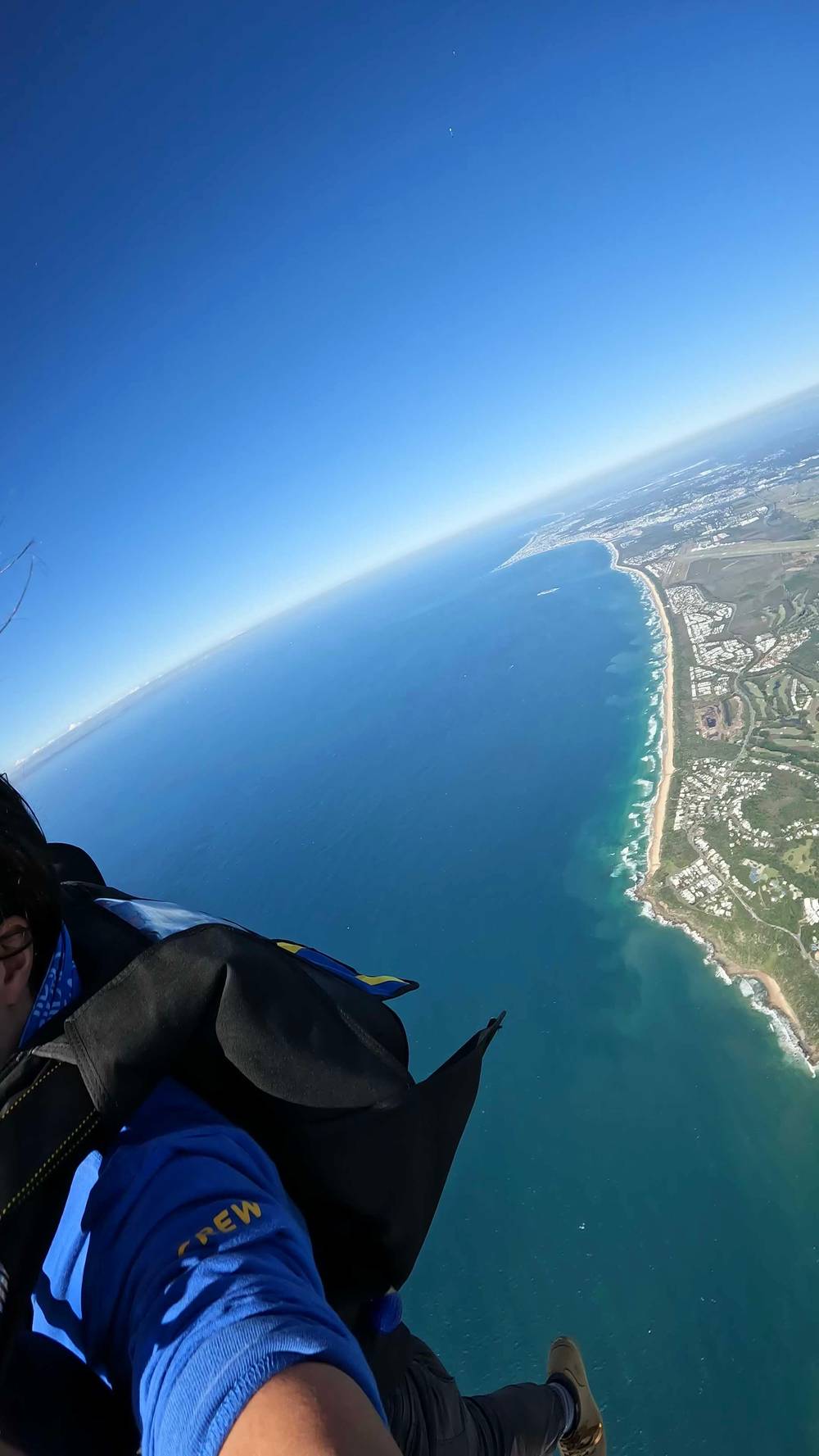
Alexia Kaybee on YouTube · Nothing is fetched until you hit play.
The official tropical cyclone season in the Australian region runs from 1 November to 30 April
Weather plan
Give the weather room
When you book3
Planning around the weather
Whatever the month, plan a buffer. Skydive Australia targets 3 to 4 hours for a tandem, yet warns the day can stretch to the whole of it, with wind, cloud, rain, thermals and other air traffic all able to slow things down.19,20 Do not book a reef trip, a flight or a tour for the same afternoon unless you are happy to give up one of them, and if you can, leave the evening open as well.
Expect a message the day before. If your time moves, the operator lets you know by text on the eve of the jump, and it makes the call on cancellations on the day itself.18,16 If the weather does cancel a jump, the operator tries to find you a new date, or a different drop zone, while you are still there.21 Keeping a spare morning later in your trip turns a cancellation into a simple change of date.
Wet season trips can still work well. February has the most rain and cloud, but the averages also show some of the calmest morning winds of the year.4,14 An early booking, a spare morning and a flexible attitude are the right tools for a Cairns jump between November and April. In the dry season the same plan still makes sense; it is simply less likely to be called on, and it costs you nothing to keep.
FAQ
The short answers to your questions.
What is the best month to skydive in Cairns?
What time of day is best for a jump?
Skydive Australia recommends booking as early in the day as possible, because the weather changes during the day.3
Can you skydive in the wet season?
Broken cloud and passing showers are usually workable; downpours, gales and a thick low ceiling are not.8
When is the cyclone season?
That is the official tropical cyclone season in the Australian region, by the Bureau of Meteorology.5
Is there a sunrise skydive in Cairns?
The listing sold on this site says a sunrise skydive is offered and that sunrise jumps are limited.
How far ahead should I book in the dry season?
The operator strongly recommends one to two weeks of notice in the peak summer season.10
Is it cold at altitude in winter?
Skydive Australia recommends gloves and very warm clothes in colder months; it can get quite chilly at 15,000 ft.12
Sources
- Tourism Australia (australia.com) · Australia's seasons ↩
- Bureau of Meteorology · Climate statistics for Australian locations: Cairns Aero ↩
- Skydive Australia (operator official site) · Tandem Skydiving FAQ ↩
- NOAA · Global Summary of the Month, Station Cairns Post Office and Cairns Aero (NOAA GHCN ASN00031010 and ASN00031011), 1991 to 2020 ↩
- Bureau of Meteorology · Australian tropical cyclone season ↩
- Tourism Australia (australia.com) · Australia's seasons ↩
- Tourism Australia (australia.com) · Australia's seasons ↩
- Skydive Australia (operator official site) · Tandem Skydiving FAQ ↩
- Tourism Australia (australia.com) · Guide to Cairns ↩
- Skydive Australia (operator official site) · Tandem Skydiving FAQ ↩
- Bureau of Meteorology · Climate statistics for Australian locations: Cairns Aero ↩
- Skydive Australia (operator official site) · Tandem Skydiving FAQ ↩
- Skydive Australia (operator official site) · What to Expect on Your First Skydive ↩
- Bureau of Meteorology · Climate statistics for Australian locations: Cairns Aero ↩
- Bureau of Meteorology · Climate statistics for Australian locations: Cairns Aero ↩
- Skydive Australia (operator official site) · Tandem Skydiving FAQ ↩
- Skydive Australia (operator official site) · Tandem Skydiving FAQ ↩
- Skydive Australia (operator official site) · Tandem Skydiving FAQ ↩
- Skydive Australia (operator official site) · Tandem Skydiving FAQ ↩
- Skydive Australia (operator official site) · Terms & Conditions ↩
- Skydive Australia (operator official site) · Terms & Conditions ↩
Related guides