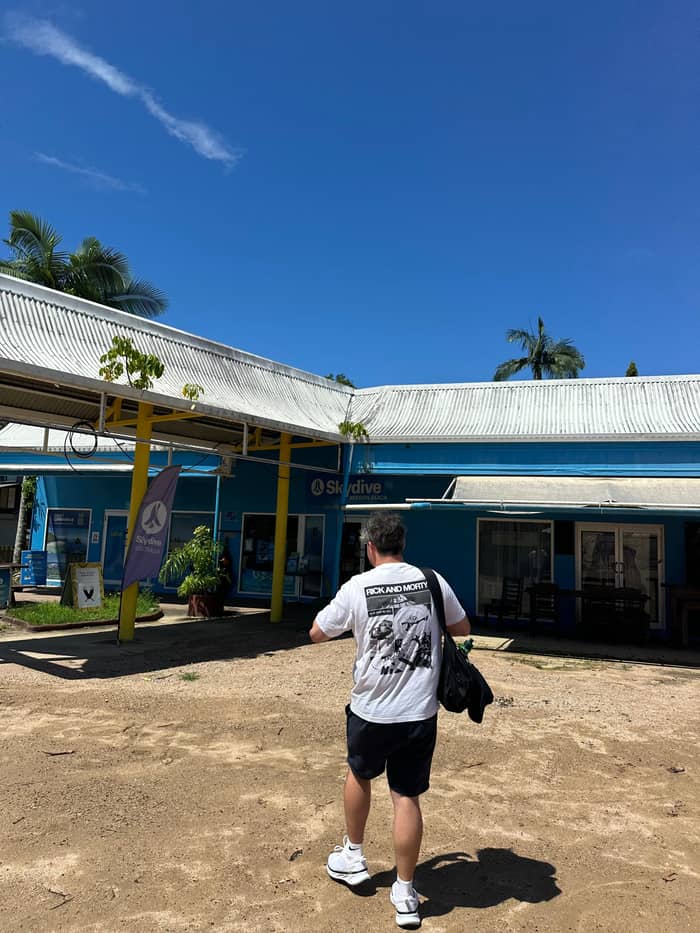
Instructor flies
Tandem
Harnessed to an instructor
- TrainingUnder 30 minutes
- Freefall30-60 seconds
- ParachuteShared
Guides
Language
Currency
Look up datesfrom $249 · free to cancelDecide with ease
The quick version
Tandem skydiving deaths are rare: USPA counted 16 civilian skydiving deaths in 3.47 million US jumps in 2025, a rate of 0.46 per 100,000 jumps.
Safety facts
Two taps to a jump
Say what would put your mind at rest and how much of the day you can give, and a matching listing appears with its from-price.
Your ideal pick
from $249
It lasts 3 hours, lands near the city and is rated 4.83 from 334 reviews.
Your ideal pick
from $270
It lands on the beach and is rated 4.83 from 191 reviews.
Your ideal pick
from $231
It lists 4 to 6 hours and a beach landing option, rated 4.84 from 251 reviews.
The honest answer starts with what official bodies publish and what they leave out: numbers from the United States and Australia, the safety layers of a tandem, and the Queensland accident report.
Editorial team, cairnsskydive.top · Updated November 8, 2026 · 7 min reading time
Summary view
How many tandem skydiving deaths per year is the first thing many people want to know before they commit, and the best public data comes from the United States. USPA, the national body there, says its members made 3.47 million skydives in 2025, and that the country recorded 16 civilian skydiving fatalities in the same year.1 Put as a rate, that is 0.46 deaths per 100,000 jumps.2 Those figures cover every kind of skydive, from first tandems to experienced wingsuit flights.
Neither USPA's safety page nor CASA's sector profile breaks the fatalities out for tandem jumps alone, so any precise tandem-only figure you see quoted online should be read with care. What the official data does show is the scale of the activity in Australia: CASA says parachuting sees approximately 360,000 jumps a year, including 175,000 tandem jumps.3 Tandems are a large share of all the jumps made here, so the people strapped to an instructor are far from a rare case.
CASA also publishes the aircraft side of the picture. From 2014 to 2023, the ATSB logged 207 reported occurrences on Australian parachute-dropping flights.6 Of those, 14 were accidents and 3 of the accidents were fatal.7 CASA's table adds that the accidents involved 8 fatalities and 5 serious injuries over the decade.8 These are aircraft occurrences, not parachute outcomes, and they count every type of jump flight in the country.
Know what you are reading
| Figure | Value | Source | Covers |
|---|---|---|---|
| Deaths per 100,000 jumps | 0.46 | USPA, 20252 | All US skydives |
| Civilian fatalities | 16 | USPA, 20251 | United States |
| Reserve rides | 1 per 726 jumps | USPA, 202518 | USPA members |
| Jumps per year | About 360,000 | CASA3 | Australia, all jumps |
| Tandem jumps per year | About 175,000 | CASA3 | Australia |
| Jump-flight accidents | 14, 2014 to 2023 | CASA, ATSB data7,6 | Aircraft side |
No figure here counts tandem deaths alone; each comes from the body named, for the scope given.1,3,6
How deadly is skydiving compared with what you might expect? The USPA rate of 0.46 deaths per 100,000 jumps gives a sense of scale: a single skydive carries a very small risk, but not zero.2 CASA's own wording is careful and worth keeping in mind. In its words, sport aviation carries more risk than a seat on a commercial flight, and that sentence is a fair summary of where a tandem sits.14
CASA also asks for what it calls informed participation, by which it means knowing what could go wrong, and what that would mean for you, before you pay or take part.15 Skydive Australia's terms carry a matching risk warning, describing parachuting as dangerous by its very nature.16 Reading those lines before you jump is part of the deal, and it is better to sign a waiver understanding it than to skim it.
Injury numbers help as well. USPA says 5.6% of its members were hurt badly enough to need medical treatment in 2025, and ankles injured on landing topped the list.17 For a tandem passenger, the landing is the moment where your own part matters most, which is why the briefing spends time on it and why you are asked to stay with your instructor in the landing area.10,13
Is tandem skydiving safer than solo? No official body publishes a direct comparison, but USPA explains where accidents come from, and that explanation points one way. It says the vast majority of skydiving accidents are the result of simple human error rather than equipment failure.4 Many happen when a jumper, often an experienced skydiver pushing the limits, makes an error of judgement while landing a perfectly functioning parachute.26
On a tandem, the decisions that go wrong in those accidents belong to the instructor. Skydive Australia says no experience is needed because a professional instructor is clipped to you and runs every technical step, taking charge at the exit.19,20 The site's listing says every jump is with a CASA-certified instructor. Only certain highly experienced Tandem Masters take customers over 94 kg.27
A first solo jump is a different kind of risk. On accelerated freefall you wear your own parachute and fall beside, but not harnessed to, 2 instructors, after several hours of ground school.28,29 On instructor-assisted deployment there is very little freefall at the start, introduced gradually from around the 6th jump.30 In both, you deploy and fly your own canopy, which is exactly the part USPA links to most accidents.
First-jump methods
Instructor flies
Harnessed to an instructor
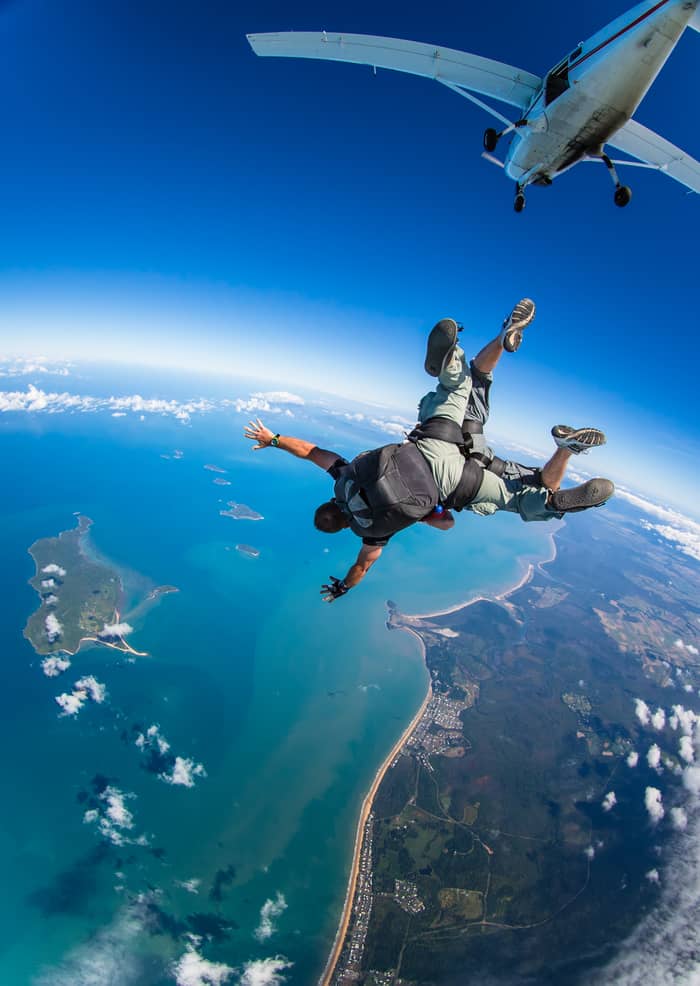
Instructors beside you
Your own parachute
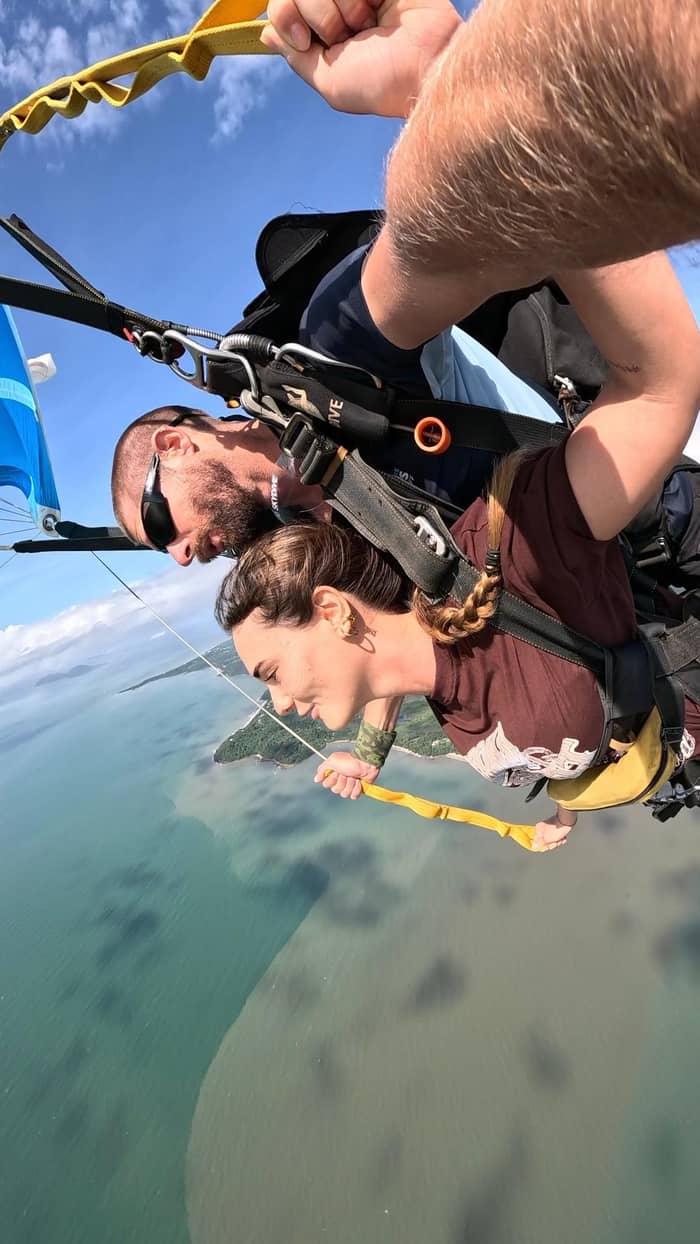
Freefall comes later
Exit solo
Equipment is the first layer. USPA says every rig carries a main canopy and a reserve, and every student rig adds an automatic activation device: an electronic unit that fires the reserve when the main has not been deployed.5 At least 90% of experienced skydivers fit the same device by choice.34 In Australia, CASA's Part 105 rules include requirements for reserve parachute assemblies and for aircraft used for tandem parachutists.35
Procedure is the second. Skydive Australia says that on the very rare occasion a parachute does not open completely or properly, your instructor releases that canopy and pulls the reserve.12 USPA's survey estimates 4,777 reserve rides in 2025, about 1 reserve use per 726 jumps, a reminder that the backup is part of everyday skydiving rather than a theory.18 The check-in weigh-in matters too: weight affects aircraft balance, climb rates and equipment.36
Oversight is the third. In Australia, every parachute operator needs to be authorised by a self-administering organisation approved under Part 105, and CASA names the Australian Parachute Federation as the body that runs the rules for most parachuting in the country.32,37 CASA's sector profile, drawn from the APF's data, lists 43 parachuting operators.38 The system is self-administered: CASA sets the regulations, and those organisations apply and enforce them.39
Layer by layer
At check-in
Weight is matched to instructor and equipment.9
Before the jump
The jump, body position in freefall and landing.10
Gear-up
You are attached to your instructor for the whole jump.11
In the air
Student systems carry an automatic activation device.5
If needed
The instructor releases a faulty canopy and pulls the reserve.12
On the ground
Landing areas can hide hazards; stay with your instructor.13
People searching for a skydiving accident near Cairns usually find one official report. The Australian Transport Safety Bureau investigated an event on 20 September 2025, when a Cessna 208 dropping skydivers for the Far North Freefall club took off from Tully Airport, south of Cairns.21 The jump was part of an annual event in which experienced parachutists build large formations in freefall; it was not a tandem load.22 The aircraft carried 17 parachutists.40
According to the ATSB, when the first parachutist stepped out to the front of the door, their reserve handle snagged on the wing flap, deploying the reserve parachute, which then wrapped around the tail.41 The parachutist sorted out the tangled lines and regained enough control of the main parachute to land with no further trouble.23 Despite control difficulties, the pilot landed the aircraft safely at Tully Airport.24
That is the whole of it: no tandem passenger was involved, and both the jumper and the pilot came down safely. USPA makes a useful point about reading such reports: a drop zone that reports more incidents is usually one that makes more jumps, not one that is less safe.42 It also encourages you to ask a drop zone directly about its safety record, adding that they have been asked before.31
Video
Wisconsin Skydiving Center on YouTube · Nothing is fetched until you hit play.
Many think that equipment failure causes most skydiving accidents, but the reality is that the vast majority are a result of simple human error.
Ask before you book
Put the pieces together and a tandem looks like this: a very small risk on any single jump, a system built with backups at every stage, and an instructor who carries the decisions that cause most accidents among experienced jumpers.2,5,4 It is not risk-free, and no official body says it is. What you can control is the honesty of your medical declaration, your attention at the briefing and your behaviour at landing.
Be open about your health. Skydive Australia asks to be told about recent injuries, surgery, epilepsy or heart conditions before booking, and USPA notes that drop zones usually require you to disclose medical conditions that could affect the safety of a skydive.25,43 The operator's terms add that a cold, the flu, or trouble clearing your sinuses or ears on the day can lead to complications.33 If in doubt, ask a doctor before you book.
Then trust the process and the people. The operator never recommends going off the forecast and makes all weather decisions on the day; that applies to safety as much as to the view.44 If a load is held for wind or cloud, it is held for a reason. Ask questions at the counter, tell your instructor if you are nervous, and let a well-practised routine carry you through to the open door and beyond.45
FAQ
USPA reports 16 civilian skydiving fatalities in 2025, from 3.47 million skydives made by its members.1
That is USPA's 2025 rate index across all kinds of skydive, not tandems alone.2
CASA says parachuting sees approximately 360,000 jumps a year, including 175,000 tandem jumps.3
USPA says the vast majority of accidents result from simple human error, not equipment failure.4
Sources
Related guides
Nervous about the jump? Ask a real person here.